

Web development trends Australian businesses can't ignore in 2026
• 9 min read
If your website still behaves like a digital brochure, 2026 is the year that might become a problem.
Australian (and global, if we’re being honest) businesses are operating in a web environment shaped by four forces at once: AI is accelerating content production, customers expect faster and smoother experiences, privacy standards are tightening, and trust is harder to earn online. At the same time, Google continues to recommend strong Core Web Vitals as part of a better overall page experience.
That matters because most businesses do not lose leads through one dramatic failure. They lose them through friction: a page that feels slow on mobile, a form that lags when someone taps it, content that sounds generic or AI-generated, tracking that misses the real source of enquiries, or a site that just doesn’t feel trustworthy enough to convert.
This article breaks down the web development trends Australian businesses should be paying attention to in 2026, what they mean in plain English, and where they can affect revenue, not just code.
Why 2026 feels different
The web has always changed. What is different now is the speed of convergence.
AI has made it easier than ever to publish pages, launch copy, and roll out features quickly. That sounds positive until every second competitor is doing the same thing with the same tools. The result is a flood of average digital experiences. The businesses pulling ahead are not the ones publishing the most. They are the ones pairing speed with clarity, trust, and usability.
In Australia, privacy and digital trust are also moving higher up the business agenda. That makes data handling, consent, and transparency more than technical concerns. They now sit much closer to brand trust, compliance, and customer confidence than they used to.
Here is what these global shifts mean for Australian businesses in particular: an average website now creates more hidden cost than it used to. Slow pages waste paid traffic. Weak trust signals reduce enquiries. Poor analytics distort marketing decisions. And generic AI-built content makes it harder to stand out.
Performance and Core Web Vitals are now more important than ever
Website performance is no longer a nice extra. It is the baseline. Setting up a WordPress site and installing a performance optimisation plugin is just not enough.
For most businesses, the two metrics worth understanding first are LCP and INP. LCP, or Largest Contentful Paint, is how long it takes for the main visible content to appear in the browser viewport, when the main content of the page is visible to users. INP, or Interaction to Next Paint, measures how quickly the page responds when a user clicks, taps, or types. In plain terms, your page might technically load, but still feel sluggish when somebody tries to use it.
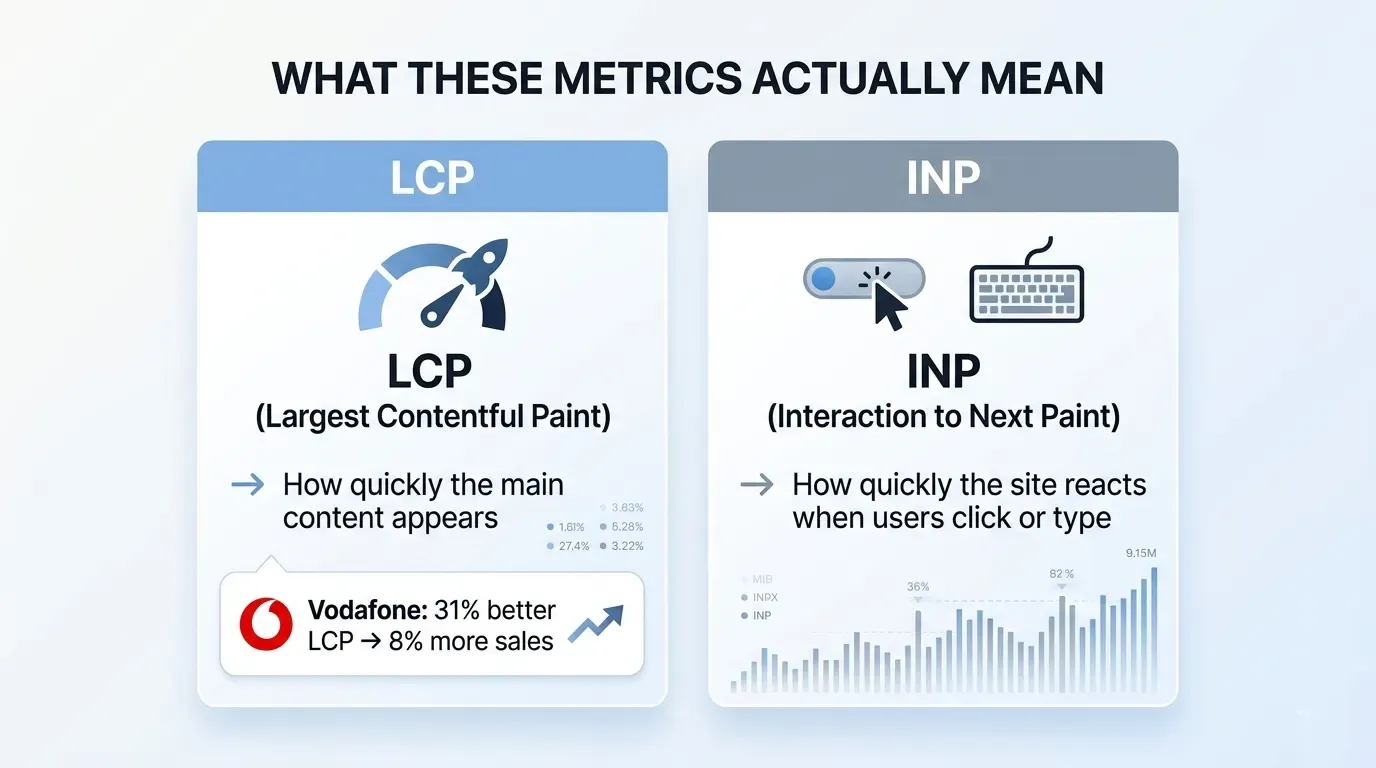
That distinction matters because users do not judge your site by developer terminology. They judge it by feel. If a menu hangs or a page feels slow on mobile, the experience feels broken even when everything is technically “working”.
This is not just a technical argument. It has measurable commercial impact. In one widely cited performance case study, Vodafone found that improving Largest Contentful Paint by 31% led to 8% more sales. That is the kind of result business owners should pay attention to.
For Australian SMEs, the takeaway is simple: improving website speed for conversions is no longer a specialist SEO task. It is revenue work. If you are running campaigns, ranking in search, or depending on enquiry forms, your mobile performance matters more than your team probably thinks.
AI-assisted content and web experiences are going mainstream
AI is now part of normal web production. Heck, we can probably go one step further and even say that AI is now essential.
Businesses are using it to draft service-page copy, write FAQs, summarise reviews, generate ideas, support chat experiences, recommend products, and speed up maintenance workflows. For smaller teams, that leverage is real. Used well, AI can reduce turnaround time and help marketing teams move faster.
But there is a problem with treating AI as the strategy rather than the tool.
AI can produce content quickly, but speed alone does not create value. When every business can generate ten pages in an afternoon, the advantage shifts to structure, originality, and usefulness. The websites that perform best in 2026 will be the ones using AI to support a sharper customer journey, not just inflate page count.
The same applies to AI website builders. They can be useful for prototypes and simple brochure sites, but they often produce lookalike layouts, vague copy, weak site architecture, and bloated output. That becomes a problem once you need stronger SEO, better conversion flows, cleaner integrations, or more deliberate brand positioning.
The smart use of AI and privacy in website design is not “replace the team”. It is “remove low-value effort so the team can focus on positioning, UX, testing, and conversion”.
Security and trust signals matter more than ever
Customers may not understand your hosting stack, but they absolutely understand when your website feels unsafe.
If they see browser warnings, broken HTTPS, strange redirects, spam pages, downtime, hacked websites - trust disappears quickly. And for most small businesses, trust is not an abstract brand concept. It is the difference between a lead and a bounce.
At a minimum, SMEs should expect proper HTTPS, SSL configuration, routine software updates, off-site backups, uptime monitoring, and some form of bot and DDoS protection. That is one reason Cloudflare is so widely used across modern websites: it can combine content delivery, caching, DNS, security tooling, and DDoS mitigation in one layer.
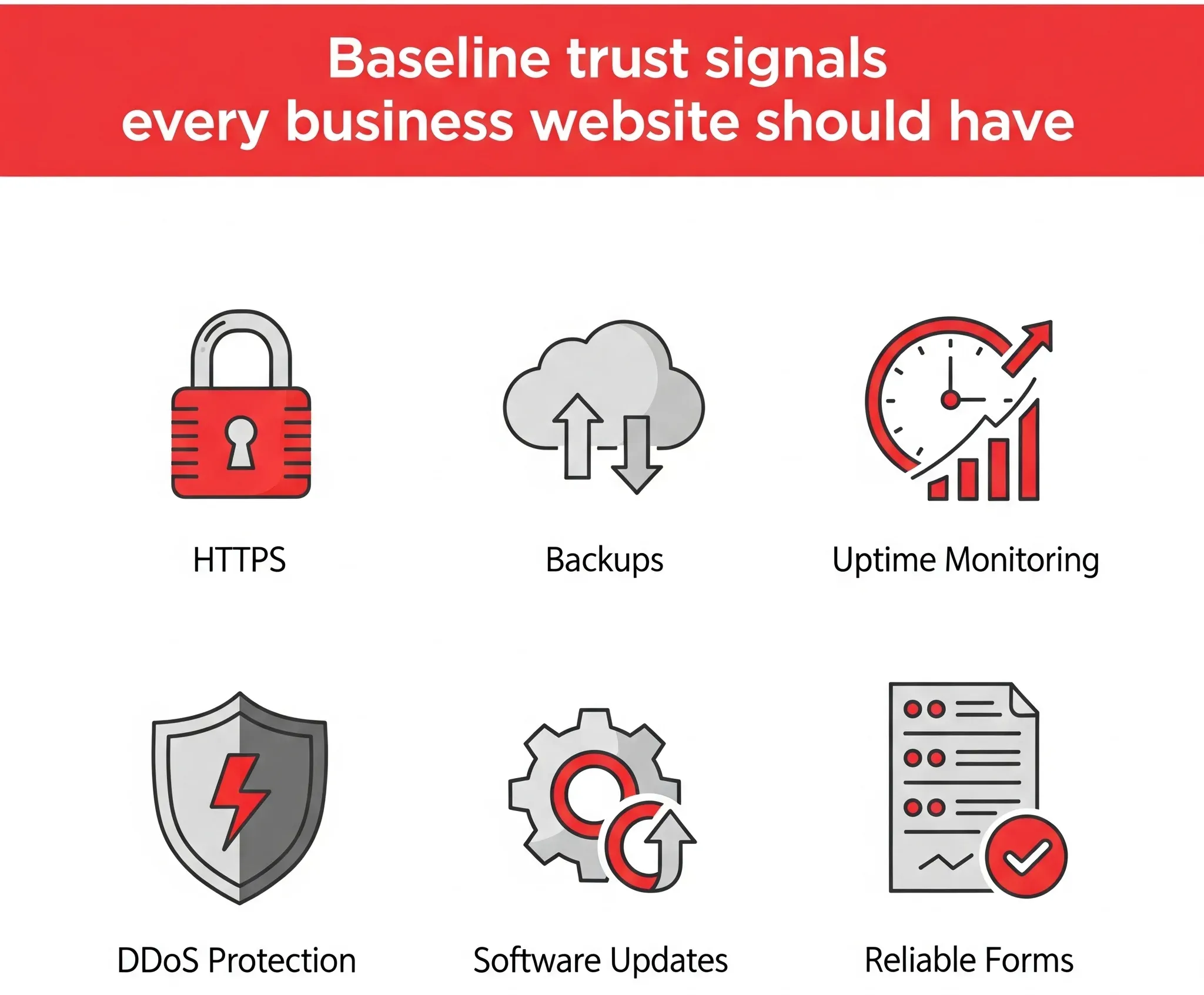
Australian businesses should not assume they are too small to be targeted. Many attacks are opportunistic and automated. A vulnerable website does not need to be famous to be worth exploiting. If you look at your server logs, we guarantee that you will see hundreds if not thousands of automated attempts trying to find vulnerabilities.
That is why security belongs in the growth conversation, not just the IT one. Downtime during a campaign, a hacked contact form, or a compromised site can damage your reputation faster than most businesses recover from. And in some cases it could even have severe financial penalties, especially if you’re dealing with sensitive data.
Once your site is fast and secure, the next issue is flexibility: how quickly you can launch campaigns, update content, and improve features without reintroducing bloat.
Headless builds and modern frontends are becoming more practical
If anything, 2026 is the year of the “You don’t need WordPress, you need Astro” debate on LinkedIn. Not every business needs a headless website. But more businesses should understand why the option exists.
Modern frameworks like Astro are pushing a static-first model that helps pages load faster by default. That matters because many traditional CMS-driven sites still send too much JavaScript to the browser for pages that do not need it. That slows down mobile performance, hurts responsiveness, and makes SEO harder than it needs to be.
But how much faster, you might be wondering? Well, to give you an example, this very site was previously built with WordPress. Since migrating to Astro, we’ve nearly halved our load times across all key performance metrics.
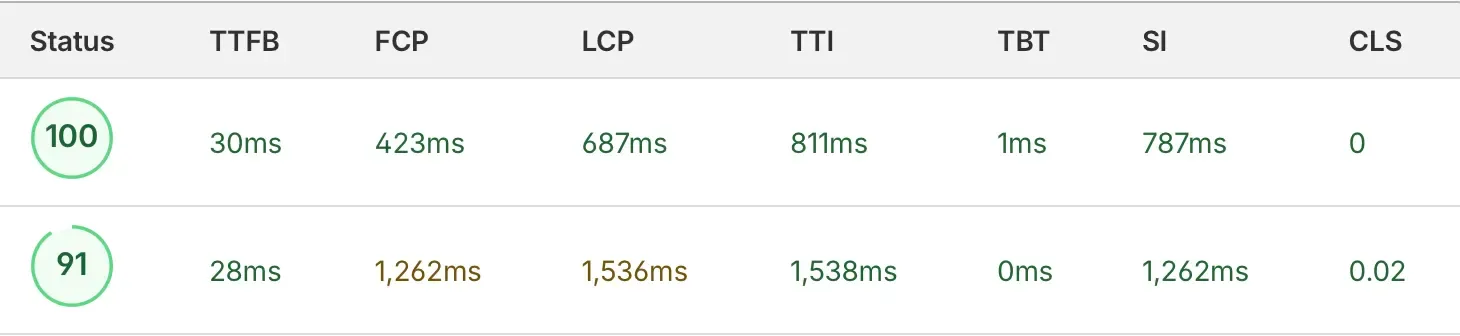
Astro is a strong example of the static-first approach, but it is not the only one. Next.js remains a major option for businesses that need richer application behaviour, and frameworks like Qwik explore performance-first ideas such as resumability. The right choice depends less on trendiness and more on how much complexity your site genuinely needs.
For modern web development for small businesses, this creates a more realistic middle ground than the old “WordPress or custom build” debate. A static-first or hybrid setup can make a lot of sense for service businesses, content-heavy sites, SEO landing pages, and lean ecommerce frontends where speed matters. In other cases, a traditional CMS still makes sense because the team needs familiar editing tools and simpler publishing workflows.
The question is not whether modern frameworks are trendy. The real question is whether your current setup is helping or hurting speed, SEO, flexibility, and ongoing maintenance.
Privacy, analytics, and first-party data are becoming business priorities
The easy era of collecting everything and figuring it out later is over.
As browser privacy restrictions and consent expectations tighten, relying on fragile third-party tracking is becoming riskier. For many SMEs, that makes first-party event tracking and cleaner server-assisted measurement more important than they were a few years ago.
For businesses, this has a practical consequence: many analytics setups are either incomplete, overcomplicated, or both. Some are still relying on basic client-side tracking that misses important lead activity. Others throw in a cookie banner and assume the problem is solved. Neither approach is strong enough on its own.
A better path is usually more disciplined, not more complex. Track the events that actually matter. Make consent clear. Reduce unnecessary scripts. Use first-party data thoughtfully. And where appropriate, move parts of measurement server-side or through privacy-safer approaches that rely on consented first-party data rather than brittle third-party assumptions.
The goal is not to over-engineer your stack. It is to get cleaner signals about what is driving leads while respecting privacy expectations.
What this means for Australian businesses
Most Australian SMEs do not need to chase every new framework, AI tool, or analytics trend.
They do need to stop treating the website as a one-off project that gets launched and forgotten.
The businesses getting stronger returns from the web in 2026 are usually doing the basics well, but they are doing them consistently: performance is monitored, UX is reviewed, trust signals are maintained, security is taken seriously, and analytics are set up to support decisions rather than guesswork.
That is the real shift. A website is no longer just a marketing asset. It is operating infrastructure.
5 questions to ask your current site or agency
- 01
Do we know how our site performs on real mobile devices, not just in a desktop speed test?
- 02
Can we clearly explain how the site helps conversions, not just how it looks?
- 03
Are our security, uptime monitoring, backups, and protection layers actively managed?
- 04
Is our current tech stack helping us stay fast and flexible, or adding bloat and maintenance drag?
- 05
Do we trust our analytics and lead tracking enough to make marketing decisions confidently?
If those answers are vague, assumed, or based on outdated reports, there is probably work to do.
Final thoughts
The gap between an average website and a high-performing one is widening.
In 2026, speed matters more, trust matters more, privacy matters more, and AI is raising both the floor and the noise. That creates pressure, but it also creates opportunity. Businesses that treat their websites as active business assets rather than passive brochures are in a much better position to win attention and convert it.
Curious where your website stands?
Request a free vCore Performance & UX Review and get a practical breakdown of where speed, trust, and tracking issues may be costing you leads.